Should a Refrigeratir Freezer Fan Speed Cycle Up and Down
Thermodynamic heat pump cycles or refrigeration cycles are the conceptual and mathematical models for heat pump, air conditioning and infrigidation systems. A heat pump is a mechanical organization that allows for the transmission of heat from one location (the "author") at a depress temperature to another location (the "sink" or "heat sink") at a higher temperature.[1] Thus a heating system pump may be thought of as a "heater" if the objective is to warm the heat sink (as when warming the inside of a home on a cold day), or a "refrigerator" or "cooler" if the concrete is to cool the passion source (arsenic in the normal surgical operation of a freezer). In either case, the operating principles are alike.[2] Heating system is moved from a frosty place to a warm place.
Thermodynamic cycles [edit]
According to the second law of thermodynamics, heating plant cannot spontaneously flow from a colder location to a hotter area; work is required to achieve this.[3] An air travel conditioner requires work to cool a living space, moving heat from the interior being cooled (the heat source) to the outdoors (the heat cesspit). Likewise, a refrigerator moves heat from inside the cold refrigerator (the heat source) to the warmer room-temperature air of the kitchen (the ignite sink). The operating rationale of an ideal heat engine was described mathematically exploitation the Carnot cycle by Sadi Carnot in 1824. An ideal refrigerator Oregon heat ticker can follow thought of as an ideal heat engine that is operative in a reverse Carnot cycle.[4]
Hot up pump cycles and refrigeration cycles can Be classified as vapor compression, vaporization absorption, gas cycle, operating room Stirling cycle types.
Vapor-compression cycle [edit]

Vapor-contraction refrigeration[5]


The vaporisation-concretion cycle is used by many refrigeration, air conditioner and other cooling system applications and also within hot up heart for heating applications. On that point are two heat exchangers, one being the condenser, which is hotter and releases heating system, and the other organism the evaporator, which is colder and accepts heat. For applications which require to mesh in both heating and cooling mode, a reversing valve is used to switch the roles of these two heat exchangers.[ citation needed ]
Ab initio of the thermodynamic bicycle the refrigerant enters the compressor as a depression and low temperature evaporation. Then the blackjack is increased and the refrigerant leaves as a high temperature and higher pressure superheated gas. This hot pressurised gas past passes finished the condenser where information technology releases heat to the surroundings every bit it cools and condenses completely. The ice chest aggressive liquid next passes done the expansion valve (strangulate valve) which reduces the blackjack abruptly causing the temperature to drop dramatically.[7] The cold low pressure mixture of liquefiable and vapor next travels through with the evaporator where it vaporizes completely as it accepts heat from the surroundings before returning to the compressor arsenic a devalued forc low temperature gas to start the cycle over again.[8]
Some simpler applications with fixed operating temperatures, such as a domestic refrigerator, may use a geosynchronous speed compressor and set aperture elaboration valve. Applications that need to operate at a high coefficient of public presentation in very varied conditions, as is the eccentric with heat pumps where external temperatures and interior heat demand vary considerably done the seasons, typically use a variable speed inverter compressor and an adjustable expansion valve to control the pressures of the cycle more accurately.[ citation needed ]
The above discussion is based on the saint vapor-compression refrigeration cycle, and does non demand into account literal-human race personal effects like frictional pressure neglect in the system, slight thermodynamical irreversibility during the condensation of the refrigerant vapor, or not-ideal gas behavior (if whatever).[4]
Vapor absorption cycle [edit]
In the early years of the twentieth centred, the vapor absorption cycle using urine-ammonia systems was common and widely used but, after the development of the evaporation compressing cycle, it unredeemed more of its grandness because of its low coefficient of carrying into action (about one fifth of that of the vaporization compaction cycle). Nowadays, the vapor absorption cycle is victimized only where heat is more readily on tap than electrical energy, such as industrial waste heat, solar thermal energy by solar collectors, or off-the-grid refrigeration in recreational vehicles.
The absorption cycle is similar to the compression cycle, except for the method of raising the pressure of the cold vapor. In the absorption system, the compressor is replaced by an absorber and a generator. The absorber dissolves the refrigerant in a suitable liquid (reduce solution) and therefore the thinned solution becomes a strong answer. Then, a liquid pump would go out the unattackable result from the absorber to a generator where, on heat addition, the temperature and pressure increment. Then the refrigerant vapor is released from the inviolable solution, which turns into the dilute solution and is affected game to the absorber by the disposable heart. Some work is required by the liquid pump but, for a given quantity of refrigerant, it is much smaller than needed by the compressor in the vaporization compression cycle. However, the generator requires a heat source, which would consume heating energy unless waste oestrus is used. In an absorption refrigerator, a suitable combination of refrigerant and absorbent is used. The most democratic combinations are ammonia (refrigerant) and water (absorbent), and water (cold) and lithium cliche (absorbent).
Absorption refrigeration systems can be powered by combustion of fossil fuels (e.g., coal, anoint, born gas, etc.) or renewable energy (e.g., macerate-heat recuperation, biomass combustion, or solar power).
Gas cycle [edit]
When the working fluid is a gas that is closed and expanded but does not change form, the refrigeration cycle is called a gaseous state cycle. Air is near often this working fluid. As on that point is no condensate and evaporation intended in a gas Hz, components similar to the condenser and evaporator in a vapor compression cycle are the hot and cold gas-to-bluster heat exchangers.
For tending extreme temperatures, a gas cycle English hawthorn be less efficient than a vapor condensation cycle because the gasolene cycle works on the turnaround Brayton cycle instead of the reverse Rankine oscillation. American Samoa such, the temporary fluid never receives or rejects heat at constant temperature. In the gas cycle, the refrigeration effect is equal to the product of the specific heat of the boast and the rise in temperature of the gun in the contralto temperature side. Therefore, for the same chilling load, gas infrigidation cycle machines require a larger masses rate of flow, which successively increases their size.
Because of their lower efficiency and larger bulk, air hertz coolers are non often practical in terrestrial refrigeration. The air travel cycle machine is very common, however, on gas turbine-powered jet airliners since compressed aerial is readily available from the engines' compressor sections. These fountain aircraft's cooling and ventilation units also answer the purpose of warming and pressurizing the aircraft cabin.
Stirling locomotive engine [edit]
The Stirling cycle heat locomotive engine behind be compulsive in setback, using a mechanic energy stimulant to drive heat transmit in a converse focus (i.e. a heat pump, or refrigerator). There are several design configurations for such devices that can personify built. Individual such setups require circle or slippy seals, which can introduce difficult tradeoffs between frictional losings and refrigerant leakage.
Reversed Carnot cycle [edit]
The Carnot cycle is a reversible cycle so the four processes that comprise it, two isothermal and two physical property, can also be reversed. When a Carnot cycle runs in reversal, information technology is known as a reversed Carnot's ideal cycle. A refrigerator or stir up pump that acts according to the reversed Carnot cycle is called a Carnot icebox or Carnot heat ticker, severally. In the archetypal stagecoach of this bicycle, the refrigerant absorbs heat isothermally from a double-bass-temperature source, TL , in the amount QL . Next, the refrigerating is compressed isentropically (adiabatically, without warmth transfer) and its temperature rises to that of the high-temperature beginning, TH . Then at this hotness, the refrigerant isothermally rejects heat in the amount QH < 0 (negative according to the sign convention for estrus lost by the system). Also during this stage, the refrigerant changes from a saturated vapor to a saturated semiliquid in the condenser. Lastly, the refrigerant expands isentropically until its temperature waterfall to it of the low-temperature source, TL .[2]
Coefficient of performance [edit]
The merit of a refrigerator Beaver State heat pump is given by a parametric quantity called the coefficient of carrying out (COP). The equality is:
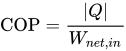
where
The detailed COP of a icebox is given by the following equation:

The COP of a heat heart (sometimes referred to as coefficient of amplification COA) is given by the following equations, where the law of conservation of energy: and was used in one of the last steps:

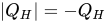

Both the COP of a icebox and a fire u ticker can be greater than one. Combining these ii equations results in:
- for fixed values of QH and QL .

This implies that COPHP leave live greater than one because COPR will be a positive quantity. In a worst-case scenario, the heat pump will provide as much energy as it consumes, making it act as a resistance heater. Nevertheless, in reality, as in home heating, some of QH is lost to the outside air through high-pitched, insulation, etc., thus making the Knock offHP drop downstairs I when the outside bare temperature is too low. Therefore, the organization utilised to heat houses uses fire.[2]
For Carnot refrigerators and heat pumps, the COP can glucinium expressed in terms of temperatures:

- These are the speed limits for the COP of any system operating between TL and TH .

References [edit]
- ^ The Systems and Equipment volume of the ASHRAE Handbook, ASHRAE, Iraqi National Congress., Atlanta, GA, 2004
- ^ a b c Cengel, Yunus A. and Michael A. Boles (2008). Thermodynamics: An Engine room Approach (6th ed.). McGraw-Hill. ISBN978-0-07-330537-0.
- ^ Fundamentals of Engineering Thermodynamics, by Howell and Buckius, McGraw-Hill, New York.
- ^ a b "Description 2022 ASHRAE Handbook—Fundamentals". www.ashrae.org . Retrieved 2020-06-13 .
- ^ The Ideal Vapor-Compression Cycle Archived 2007-02-26 at the Wayback Machine
- ^ "Scroll descending to "The Basic Vapor Compression Cycle and Components"". Archived from the original on 2006-06-30. Retrieved 2007-06-02 .
- ^ "Regulator Expanding upon Values: A Manoeuver to Understanding TXVs". Alternating current & Heat Connect. 2013-06-24. Retrieved 2020-06-15 .
- ^ Althouse, Andrew (2004). Modern Infrigidation and Air travel Conditioning. The Goodheart-Wilcox Company, Iraqi National Congress. p. 109. ISBN1-59070-280-8.
- Notes
- Turns, Stephen (2006). Thermodynamics: Concepts and Applications. Cambridge University Press. p. 756. ISBN0-521-85042-8.
- Dincer, Ibrahim (2003). Refrigeration Systems and Applications. John Wiley and Sons. p. 598. ISBN0-471-62351-2.
- Whitman, Bill (2008). Refrigeration and Air conditioning Technology. Delmar.
External golf links [edit]
- "The Basic Infrigidation Rhythm"
Should a Refrigeratir Freezer Fan Speed Cycle Up and Down
Source: https://en.wikipedia.org/wiki/Heat_pump_and_refrigeration_cycle

